
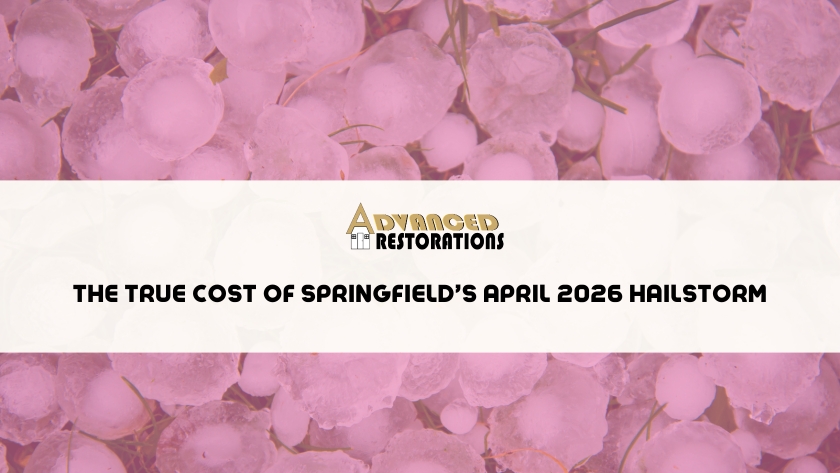
On April 28, 2026, a severe thunderstorm complex moved over Springfield, dropping hail up to 4.75 inches in diameter. To put that into perspective, the hailstones were roughly the size of a CD, shattering a 75-year hail-size record for Greene County by nearly two full inches. As the community moves from immediate recovery to long-term rebuilding, the financial scope of this historic event is becoming clear, fundamentally changing how homeowners must approach roof replacement.
The Staggering Local Impact
The sheer scale of destruction left behind by the April storm was unprecedented for the immediate area.
- Massive Financial Toll: Joint preliminary damage assessments estimated over $36 million in damages for Greene County alone.
- Statewide Context: Historically, the entire state of Missouri averages approximately $49.7 million in hail-related financial losses over a full year. A single afternoon in Springfield accounted for a massive portion of the state’s typical annual damage.
- Community Facilities: Springfield Public Schools reported an estimated $15 million in damages, primarily to the roofs and HVAC systems of a dozen buildings.
Because the damage throughout the region far exceeded local capacity, Governor Mike Kehoe formally requested federal disaster assistance through FEMA. While the April 2001 St. Louis hailstorm—which produced 2.75-inch hail and over $1 billion in damage—remains the state’s costliest overall, the 2026 storm set a new local benchmark for severity in Southwest Missouri.
Why Rebuilding Costs More Today
For homeowners navigating the recovery process, the financial landscape of roof replacement has shifted significantly compared to previous years.
- Percentage-Based Deductibles: In the past, most homeowners had flat-dollar deductibles for storm damage. Today, many Missouri insurance carriers have shifted to percentage-based deductibles for wind and hail claims to manage their risk. This means your out-of-pocket cost is tied to your home’s insured value. For example, a 2% deductible on a home insured for $300,000 requires a $6,000 out-of-pocket payment before coverage applies.
- Actual Cash Value Depreciation: Older roofs are facing steep depreciation penalties. Some policies now utilize Actual Cash Value (ACV) payouts for aging roofs, meaning the insurance company only pays for the depreciated value of the roof, not the true cost to replace it.
Investing in Proactive Defense
With the cost of severe weather rising and out-of-pocket deductibles increasing, rebuilding with standard materials leaves your home vulnerable to the exact same cycle of damage. Protecting your property against future historic events requires a shift toward proactive, all-weather defense.
Upgrading to Class 4 impact-resistant shingles is one of the smartest investments you can make in Southwest Missouri. Products like Owens Corning TruDefinition® Duration FLEX® and TAMKO StormFighter FLEX® utilize polymer-modified asphalt that allows the shingle to bend and absorb kinetic energy rather than fracturing. In independent laboratory testing, these shingles withstand the force of a 2-inch steel ball dropped from 20 feet.
Because Class 4 systems significantly reduce the risk of future storm damage, many insurance providers offer premium discounts to homeowners who install them.
Documenting Your Roof’s Health
Even if your roof didn’t actively leak during the April storm, 4.75-inch hail causes latent damage that degrades the integrity of your shingles over time. Professional documentation is the first step toward securing your home’s long-term defense.
Call 417-932-2339 to contact Advanced Restorations for a thorough assessment of your roof’s true condition.
Schedule a Free Inspection
Sep. 15, 2026
How Can You Tell How Old Your Roof Is? 5 Ways to Find Out
Sep. 08, 2026
How Long After a Hailstorm Can Roof Damage Start Leaking?
Sep. 01, 2026
What Summer Storms May Have Left Behind on Your Roof
Aug. 25, 2026
How Much Hail Damage Does a Roof Need Before It Should Be Replaced?
Aug. 18, 2026